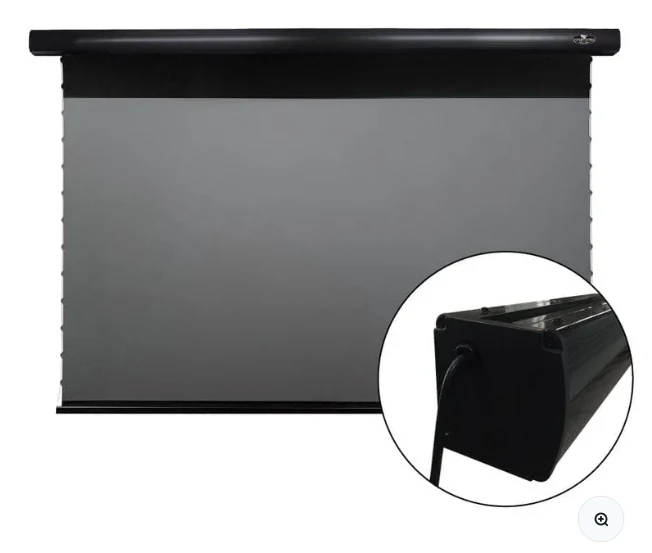
What the PRO Slimline is built to solve
A UST projector throws light upward at a steep angle. That geometry is why a generic white retractable screen is a poor default: it does not selectively reject ceiling light and it may not preserve contrast in the way a lenticular UST surface can. The PRO Slimline uses a directional ALR/CLR lenticular material, tab tensioning and a motorized housing to combine a cleaner living-room install with a purpose-built UST surface.
The current seller listing specifies a 0.6 gain, a 170° viewing angle and sizes from 84 to 120 inches. It also lists black or white housings, remote height adjustment, app control, RF/button control, USB-trigger support and wall, ceiling or suspended installation. Those are manufacturer/seller specifications, not measurements performed by Screen Clarity Lab.
The most important compatibility rule
The standard PRO is intended for a tabletop or cabinet-positioned UST projector. That detail is more important than the word “ALR.” Directional lenticular surfaces depend on the direction from which light arrives. If your UST projector is mounted above the screen, the standard PRO is the wrong orientation; the PRO A is the corresponding ceiling-mounted-projector version.
Also distinguish UST ALR/CLR material from ALR materials designed for long-throw projectors. They solve different optical geometries. A screen can be excellent in one geometry and unsuitable in the other.
Where the design makes sense
The PRO Slimline is most compelling when a permanent fixed frame is visually unacceptable, a floor-rising case would consume furniture or floor space, and you are willing to mount a long motorized cassette securely. The drop-down format can work well over windows, built-ins or multipurpose walls, but the wall and the mounting points still need to carry the housing safely.
The motor and tab-tension system add moving parts compared with a fixed frame. That is the tradeoff for a disappearing screen. Buyers who prioritize simplicity above aesthetics should compare a fixed-frame UST screen; buyers who prioritize a no-drill setup should compare a floor-rising model.
Image and brightness considerations
A gain of 0.6 means the screen is not trying to be a high-gain brightness amplifier. Its job is controlled reflection: directing useful UST light toward viewers while rejecting a meaningful amount of off-axis ambient light, especially from above. In a bright room, projector output, wall color, window direction and ceiling-light placement still matter. ALR improves the environment; it does not cancel direct sunlight.
For wide seating, the listed 170° viewing angle is favorable on paper. For large screen sizes, remember that the same projector lumens are spread over more area. Moving from 100 to 120 inches increases image area substantially, so a 120-inch picture asks more from the projector.
Installation realities to plan before ordering
Treat the housing size, viewing area, top black drop and projector geometry as a single system. Measure the planned screen centerline, furniture height, projector throw distance and the vertical offset required by your projector before drilling. The seller publishes overall housing dimensions by size, and those dimensions should drive bracket spacing and clearance planning.
Because UST alignment is unforgiving, a screen that hangs a few millimeters off-level can make setup much harder. Mount the housing level, let the material fully deploy, then align the projector to the physical screen before using digital keystone correction as a last resort.
Bottom line
The VIVIDSTORM PRO Slimline is not the simplest UST screen, but it addresses a specific problem unusually well: a retractable, wall/ceiling-mounted UST ALR surface for people who do not want a permanent fixed frame or a floor-standing cassette. The main buying decision is not “is motorized better?” It is whether this form factor fits your room, projector position and tolerance for installation complexity better than the fixed-frame and floor-rising alternatives.
Frequently asked questions
Is the VIVIDSTORM PRO Slimline only for UST projectors?
The standard PRO listing is specifically for ultra-short-throw laser projectors positioned below the screen on a cabinet or bench.
Can the PRO work with a ceiling-mounted UST projector?
Use the PRO A variant for ceiling-mounted UST geometry; the directional screen material is oriented differently.
Does it need a dark room?
No ALR screen makes room light irrelevant. The directional surface is intended to preserve contrast better under ambient light, especially overhead light, but direct sunlight and poor projector placement can still wash out an image.
Check the live VIVIDSTORM PRO listing
Confirm current size options, stock, regional pricing and included controls before planning the final mount.
See current VIVIDSTORM PRO offer ↗